Showing posts with label Sweets and Desserts. Show all posts

Saturday, 21 June 2014

Gulab Jamoon

The smooth, sweet jamoons soaked in sugar syrup. That invariably mouth-watering dessert in most Indian Buffets. Well I cannot think of anyone who would dislike this lovely dessert, except for calorific reasons ofcourse. But a celebration calls for some highly calorific dishes on the menu and we are sure to have practice sessions a couple of times atleast before the occasion to get the dish right. I am sure most of us have tried the packaged instant mix for gulab jamoon. The ingredients are anyone's guess.

Ingredients
Khova/dry evaporated milk - grated, 1 1/2 cups 
Maida/Corn Flour - 1/2 cup 
Water - just to blend

Sugar syrup
water - 1 1/2 cup
sugar - 1 1/2 cup
Cardamom - 2, crushed and powdered with the pestle
Rose essence - 3-4 drops
Lemon juice - a few drops

Method
Use your fingertips lightly  and mix the khova and maida to make a crumbly mix. Add just enough water to make a smooth dough very lightly with your fingers. Do not knead or the jamuns will turn out hard.

With this quantity of ingredients  you can make 40 medium sized jamuns. 

Place the balls of dough on a plate. 

Prepare the sugar syrup in the meanwhile. Heat the water and add the sugar, stirring slowly. Keep stirring until the sugar is completely dissolved for about 10 minutes. Do no overheat or the sugar will caramelize. 

Add the lemon juice to the syrup, to avoid the sugar from crystallizing after it cools down. Take the sugar syrup off the flame when it is of the right consistency (pourable but thick) and add the cardamom and rose essence. 

While the sugar syrup is still hot, start frying the jamun balls in oil. Keep tossing them around in medium flame, so all sides cook evenly and the jamuns do not crack. 


Drop the hot jamun balls directly into the sugar syrup.


Allow the jamuns to soak. The syrup will cool down in a couple of hours. You could serve the jamus warm or cold with a few spoons of syrup.


Verdict
Something incredibly satisfying about making something from scratch. This is one of those satisfying endeavours, to all senses including your palette ;)

priya's signature image at photobucket

Saturday, 6 April 2013

Ada Pradaman

I was introduced to Ada pradaman by a dear friend of ours hailing from Kerala. It is a heady payasam indeed. I was interested in making this at home and innocently asked our family friend Aunty for the recipe. No sooner was she half-way through the recipe, I was exhausted listening to the amount of pre-preparation this dish entailed. What pre-prepararation, you ask? How different is it from the pre-preparation for cakes and baked goodies... Not at all different and quite simple rather compared to the baking recipes. Yes, I realized that after I started baking cakes and so decided to give Ada pradaman, a shot.

I used store-bought ada and hence had to soften it before using it. Please note that the measurements given here are in 150 ml cups (rice measuring cup)

Ingredients:


Coconut milk - 1 1/2 cups
Ada - broken pieces - 1/4 cup or 8 long stands
Jagger, shredded - 1 cup
Caradamom - 1/4 tsp
Cashews - 8 to 10
Ghee - 1 tbsp
Water - as required

Method:

Heat 1/2 cup of water in a saucepan. When the water comes to a boil, add the ada to it. Let it soften in the boiling water for 2-3 minutes. Drain the hot water, run the ada through cold water and strain it well. Keep aside.
Place the shredded jaggery in a sauce pan or kadai. Pour very little water, just enough to cover the jaggery upto halfway. Heat the saucepan and leave it on simmer while the jagger melts. Use a spatula to stir it so there are no lumps. Keep aside.

Shred the coconut and extract the coconut milk. A large coconut should yield 150 ml of thick coconut milk in the first pass and another 100 ml of dilute coconut milk in the second pass. Keep the coconut milk aside.


Once the jaggery syrup has cooled down, run it through a strainer to remove any impurities. Mix the jaggery syrup into the coconut milk. Heat the sauce pan and pour the mixture into the sauce pan. Add the ada to the jaggery-coconut milk mixture. Add the cardamom. Let the mixture simmer and thicken while cooking the ada for 5-7 minutes. Keep the sauce-pan aside to cool down to ada-pradamam. Heat the ghee on a tawa or tempering saucepan and add the cashews to it. Roast the cashews until golden brown.

Pour into the cooling ada-pradamam. Serve warm or chilled. 

Optionally you can also add boiled Sabudana (Javvarisi) to the coconut-jaggery mix while adding ada. It makes an interesting and welcome addition.

Verdict: Give this a shot and it is totally worth it. Funnily, my little girl was outside playing with friends when I made this. When she came back home, I served her the ada-pradaman, and she wanted to know when our family friend aunty had come home and given the payasam. I told her I made it and she did not believe me. So I suppose this either means, she does not trust my culinary skills enough or it tasted as good as the original from Su aunty. I choose to believe the latter ;)
priya's signature image at photobucket

Wednesday, 6 February 2013

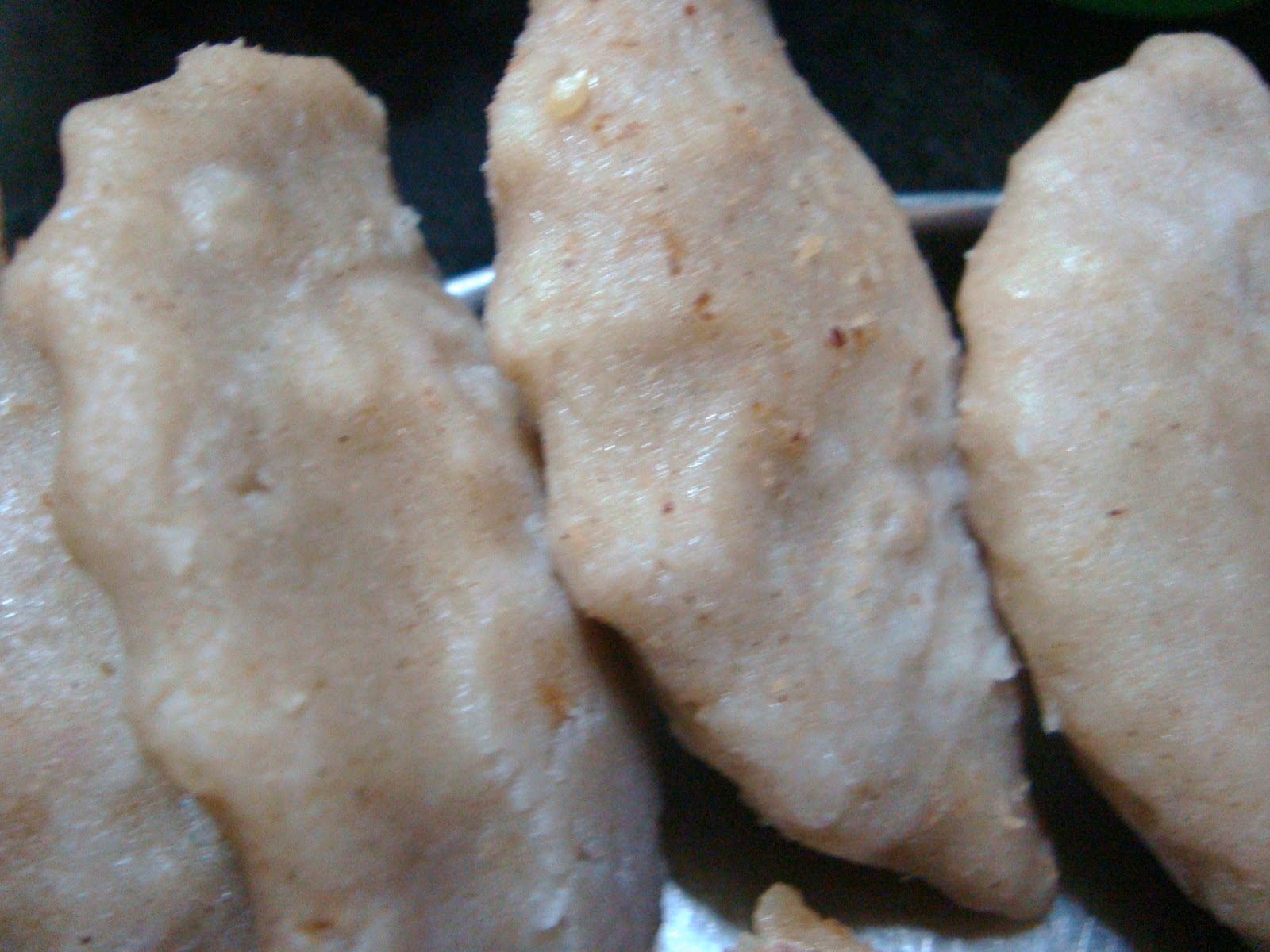
Kozhukattai

Kozhukattai or Modhak is another favourite for Ganesh Chathurthi.
It is actually quite simple to prepare. This has been lying in my drafts for more than a year now. I postponed it as I had let the rice flour brown a bit too much resulting in the dull coloured kozhukattais. I wanted to take better pictures in 2012 during Ganesh chathurthi, but I did not manage to, although the kozhukattais turned out great. So I finally decided to post it with my older pictures, pointing out the mistakes one should avoid while making kozhukattai (modhak).


Ingredients:
For the shells: 
Rice flour - 1 cup
Salt - 1 pinch
Water to knead

For the stuffing:
White Till - 1/2 cup
Grated Coconut -  1 cup
Jaggery, shredded - 1 cup
Cardamom powder - 1 pinch
Method:
Rice dough for the shell:
Heat a heavy bottomed dry vessel, and fry the rice flour till the raw smell goes. Do not let the rice flour turn brown. I let it in the heat for too long and it browned, causing these dull coloured shells. For Ganesh Chathurthi (2012), I did not let it brown and the shells turned out very white and inviting. I do not have any pictures of those kozhukattai's unfortunately. 
Remove the rice flour, let it cool and add the salt and mix well. Heat a cup of water in the vessel, and add the rice flour to it mixing slowly with a spatula. Add more hot water as required. Make a smooth dough of the rice flour.

Stuffing or Pooranam:
Roast the till until golden brown; allow it to cool. Mix the grated coconut and shredded jaggery with the cardamom. Add the till and keep aside. 

Shaping and stuffing the Modhak: 
Take some rice dough, the size of a small lemon. Form a hollow hemisphere with the dough. Take some stuffing the size of a small lemon and stuff it inside the hollow of the hemisphere. Close the hemisphere and shape the edges sealing the stuffing inside. Make a curved pattern around the sealed edge. 

Steaming the Modhak:
Place one kozhukattai each on the idli plate. I have a four plate idli, and two such plates fit into a kadai. So I place 8 kozhukattais for steaming at a time. Steam cook the kozhukattais for 5-6 minutes. Keep a close watch after 4 minutes, if the the shell seems baked, then switch off the steamer immediately. Gently loosen up the kozhukattais from the idli plate and place on a plate to cool down completely. 


Verdict: A couple of mistakes one should avoid while making the kozhukattais. Avoid roasting the rice flour too much. Use hot water to make the rice flour dough and be quick in kneading the dough, otherwise it will not be smooth. Rice flour will almost get cooked in the hot water during the kneading process. Avoid steaming the kozhukattai for too long. If you have just observed these simple precautions, you can treat yourself to kozhukattais that look as yummy as they taste :). You cannot go wrong with the taste in this recipe. So it is all about the looks. 
priya's signature image at photobucket


Thursday, 31 January 2013

Kaju Katli (Cashew Cakes)

Kaju Kathli became special to us at home after a certain incident involving my little girl.

I was particular about not giving her sweets, lest she develop a bad eating habit and fill up on sweets. Getting her to eat her meals was difficult enough without added distraction. But my father has a sweet tooth and he has the habit of getting a box of sweets from A2B (Adayar Anandha Bhavan) often, under the pretext of going to fill up petrol in the bike, and visiting A2B as it is just next to the petrol bunk. Kaji Kathli and the Dharwar Peda are his favourites from there. So she was slowly introduced to these goodies, much to my chagrin. So to keep everyone happy, we started hiding the sweets from her view.

Once, a family friend who visited us after their son's wedding, gave us a box of Kaju Kathli as a part of some custom where they distribute sweets to those who came for the wedding. Since this happened in her view, we could not hide it from her. She finished the entire box over the next 3-4 days with little help from the rest of us.

Seeing how much she relished this cashew cake, I relaxed the restriction and since then Kaji Kathli and other sweets with loads of nuts (like fruits halwa) etc, were allowed to be given to her.

For Diwali, I decided to make these for her, as it was more than two months and she had not tasted her favourites owing to my dad being out of town for a long time. I followed the recipe from Vardhini's Cook's Joy.

Ingredients:
Cashews - 1 1/2 cups - raw whole cashews
Ghee - as needed to grease
Parchment paper - 2 sheets

For the sugar syrup:
Sugar - 1/2 cup
Water - 5 tbsp

Method:

Powder the raw cashews into a coarse powder. Sugar syrup:
Heat the water and sugar in a pan. When the sugar dissolves completely, it starts boiling. First the sugar syrup will be sticky when you touch. Then it starts pulling out in a string, without breaking, when you hold a couple of drops between your thumb and index finger. It is called Kambi padham in Tamil. Alternately, start testing the syrup consistency by pouring a few drops in a plate with water. When you push the drops around, it will form thick strands in the water that do not dissolve immediately.

Kaju Katli: Add the powdered cashew to the sugar syrup when it is of the right consistency as tested above. Keep stirring and you will see the mix coming together. Wet your fingers and pinch a small portion of the mixture and see if you can form a ball. If so, turn the stove off. If the dough is not runny and you can gather it with your ladle, transfer the dough to a plate greased with ghee. If the mixture is still watery, stir in the pan for a minute or so. Then transfer it. The dough will look coarse. Grease your hands and knead the dough and you can see it turn soft. Work quickly from here on. The dough will be hot to touch, if you let it cool down before working on it, you will not be able to roll it and shape it. Roll between parchment paper into a sheet with uniform thickness of 1/4 of and inch and slice into diamonds. Kaju Katli is ready to serve.

Verdict: Well, this tastes exactly like the store (A2B) bought one. She devoured these for the next week or so. Do try it out in small batches owing to the quickness with which the dough sets.
priya's signature image at photobucket

Wednesday, 30 January 2013

Rava Laddu (Sooji Laddu)

Rava laddu is a simple, easy to make Indian sweet. It stays fresh for about a week and can be easily packed away in boxes for travel. We always make rava laddu for Diwali, other than the athirasam ofcourse. I usually do not post festival specific recipes on the blog, since those are really busy days and I often do not even get a chance to click pictures. But this time, I made it a point to take some pictures, albeit of lower resolution. But since then, I had no time to write up the recipe and post it. So without much delay here comes the recipe.
Ingredients:


Rava / Sooji- 500gm (I used the chirotti rava)
Sugar-1 1/2cups
Broken Cashew-1/4cups (optional)
Ghee-200gm
Cardamom Powder-1tsp


Method:
1. Roast rava until it changes colour. Do not let it brown.
2. If using normal rava, grind it to a fine powder in a mixer grinder. If using chirotti rava, skip this step.
3. Grind sugar into a fine powder and add it to powdered rava.
4. If using cashews, heat 1/2tsp ghee and add broken cashews.
5. Fry until golden brown.
6. Add it to the rava mixture along with cardamom powder.
7. Mix well.


8. Heat ghee and add a ladle full of hot ghee into one corner of the mixture. Mix well with a spoon.
9. Shape it into medium sized laddoo. When the ghee mixed flour is over, again add hot ghee to a portion of the rava mixture. Shape the laddoos before the ghee cools down.
10. Prepare laddoo in batches. If more ghee is added then the laddoo will not firm up, and if ghee has cooled down, the shaped laddoo will crumble. If the shaped laddoo does not crumble, but does not retain the spherical shape under its own weight, then there is too much ghee.
11. Arrange on plate and allow it to firm up.
12. Store in airtight jar, for upto a week.


Verdict: These are simple laddoos and relatively healthy compared to other Indian sweets.
priya's signature image at photobucket

Thursday, 15 December 2011

Ellu Urundai (Till Laddoo)

 
Ellu Urundai is a must have for Ganesh Chathurthi. This is so quick and easy to make, and turns out delicious. I am a huge fan of these laddoos. So without much ado. Here is the promised recipe.

Ingredients:
White till - 1 cup
Jaggery - shaved/shredded - 1 cup
Cardamom - powdered - a pinch
Turmeric - 1 pinch
We always add a pinch of turmeric to any dish that is made for a festival as as an offering to God.

Method:
In a heavy bottomed dry kadai, fry the till until it turns golden brown and the raw smell goes.
Allow it to cool down completely. As the till is cooling down, get the jaggery and cardamom ready. Shred the jaggery and gather 1 cup of it. Peel the cardamom and grind it with the mortar and pestle.

When the till is completely cool to the touch, add all the ingredients to a mixer jar and blend for 1-2 minutes. The till will be ground and oil will start oozing out, thereby making the mix pliable to forming laddoos.
Take the mixture out and quickly make laddoos. Delicious Laddoos are ready for the pooja or for you own Pete Pooja :)
priya's signature image at photobucket

Monday, 21 November 2011

Ganesh Chathurthi - Special (Delayed post)


It is that time of the year. Colourful, festive, loads of goodies at home; Every two weeks there is something to look forward to, along with all of the above, long weekends and sometimes one day break in the middle of a work week. Who wouldn't love this time of the year. Yes, I am talking about the festival season from late July to early January. That is the time of the year that we have the maximum number of holidays in India. May through July are quite the toughest months. Absolutely no holidays :(. But come Varamahalakshmi, followed by Janmashtami and then Ganesh Chathurthi, Dussherra and Diwali, the varied festivities and the different preparations for each of these keep me quite busy.

This year was a little different. There were too many challenges on the home front and I was unsure if we could keep up the festive spirit as in the previous years; but there was a welcome change at the last minute. My sis-in-law was with us during this time, and thanks to her, together we put up a wonderful treat :). We could not follow the fasting and pooja before noon; we put all the neivedhyam before the Lord only in the evening. And I suppose all items were first tasted by my daughter as soon as they were prepared. But I suppose Lord Ganesh is not complaining :)

Stay tuned for the recipe of Ellu Urundai, Parauppu Vadai, and Ellu Kozhukattai :).

priya's signature image at photobucket